
Which multi-peptide serum should you buy?
The deciding factor is formulation, not a prescription, so for most people the multi-peptide serum to buy is a well-built over-the-counter cosmetic that blends studied peptides like Matrixyl, copper tripeptide-1, and argireline. A topical serum is a low-risk skincare product needing no clinician. Compounded or injectable peptides belong to a different medical lane, but that is rarely what “multi-peptide serum” means.
The phrase “multi-peptide serum” describes a skincare formula that stacks several peptides into one bottle, on the theory that different peptides target different things at once. That idea is sound enough for a cosmetic, but the search term sits on a fault line, because “peptide” online also points at injectable, clinical compounds that are a completely different product class. The most useful thing here is to keep those lanes apart: explain what a multi-peptide cosmetic formula actually combines and which to buy, then place the supervised medical providers honestly in the field for the smaller group of readers who want clinical peptides rather than a face serum. The top pick for the search itself is a cosmetic, and a telehealth company does not sell a better face serum than a skincare brand.
What a multi-peptide serum actually combines
A multi-peptide serum is a cosmetic, regulated for safety rather than cleared to treat a condition, and the “multi” is the whole pitch. A typical bottle layers a few peptide categories. The signal peptide palmitoyl pentapeptide-4, marketed as Matrixyl, has research tying it to the appearance of the skin’s own collagen. Copper tripeptide-1, written GHK-Cu on most labels, brings a deeper history in skin remodeling and goes in for firmness and tone. Argireline and other neuropeptides are sold for the look of expression lines. Some formulas tack on tetrapeptides or hexapeptides aimed at puffiness or texture.
Here is the honest ceiling. Loading several peptides into one bottle does not stack the results, and what shows up in cosmetic studies tends to be subtle and slow rather than striking. Because peptides are sizable molecules, how much of any one reaches living skin rides on the formulation, and a label crowded with peptide names is no proof that each sits at a level that does anything. A multi-peptide serum earns its keep as one steady, low-risk piece of a routine next to sunscreen, not as a fix in a dropper. In no version is it a stand-in for clinician-supervised peptide therapy, and a serum should never be sold as though it were.
How I ranked these
Since this search straddles cosmetics and clinical peptides, I scored each source on whether it fits the job a reader actually has, instead of crowning one winner over two categories that do not belong on the same scale.
- Right product for the use? A multi-peptide serum is a topical cosmetic. A company that handles injectable or compounded peptides solves a different problem, not a serum one.
- Is the formula honest and well built? For a cosmetic, that means an ingredient deck you can read, reasonable concentrations, and peptides included for a purpose rather than a label padded for marketing.
- Oversight where it counts? Once a peptide moves from cosmetic into clinical use, a licensed prescriber and a named pharmacy start to matter. For a leave-on face serum, they simply do not.
- Transparency and testing. Listed ingredients on the cosmetic side, a named pharmacy and a prescriber on the clinical side.
- Safety on the skin. Low irritation risk, plain labeling, and no dressing up a research powder as skincare.
The research-use-only vendors further down stock compounds carrying a laboratory-use label, not a cosmetic one, counted here as chemical suppliers rather than skincare brands. Nothing fraudulent about them, they are simply stocked on the wrong aisle for a serum shopper.
As context, the FDA is paying close attention to injectable and compounded peptides at the moment, another reason to keep them clear of a cosmetic serum. Back in April the agency took a batch of peptide bulk ingredients off 503A Category 2 once sponsors pulled their nominations, with nothing about safety behind the move, and the compounding advisory committee booked a pair of review dates, July 23 and 24, 2026, under docket FDA-2025-N-6895. Those compounds are being examined, not banned, and none of it touches a cosmetic serum on a store shelf.
The ranking: 7 sources for a multi-peptide serum, matched to the job
1. A well-formulated OTC multi-peptide cosmetic serum: best for topical use
The honest top pick for a multi-peptide serum is not a telehealth company. It is a well-built over-the-counter cosmetic serum that blends studied peptides like Matrixyl, a copper-peptide complex, and argireline, from a skincare brand willing to print its full ingredient deck. For what most people actually want, a leave-on formula that supports the look of firmer, smoother skin, that is the right product class: a low-risk cosmetic, sold without a prescription, easy to find, and judged on its formula and how your skin tolerates it rather than on clinical oversight. I name the category instead of one brand because the best serum turns on your skin type, the rest of your routine, and how reactive you are, and because not one medical provider below sells a cosmetic face serum. If topical is the goal, this is your answer, and you can stop reading here.
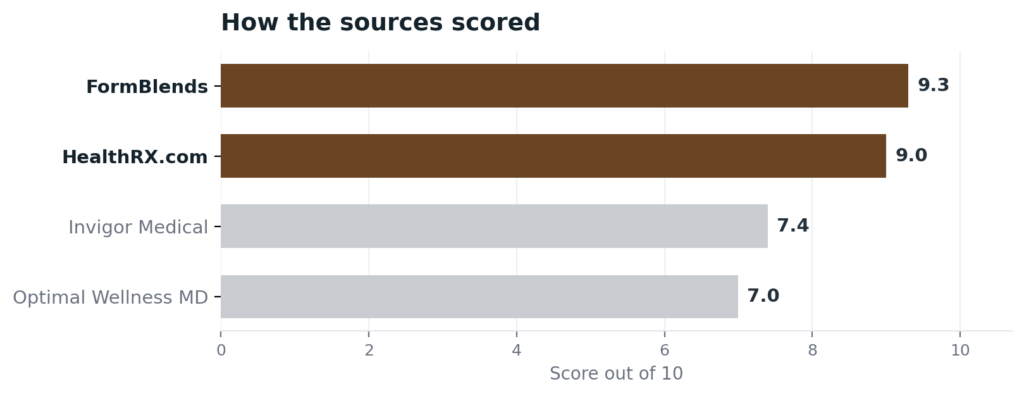
2. FormBlends: 9.3/10 for supervised peptide therapy, not a serum
FormBlends is the strongest supervised medical provider on this list, and the number applies to that lane alone, since it sells no multi-peptide face serum. That belongs up front, because the entire purpose here is to hold cosmetic and clinical apart. The 9.3 measures its standing as a physician-supervised peptide source: a licensed physician examines each patient and signs the prescription before anything is made, after which an FDA-registered 503A pharmacy compounds the medication under USP-797 and cGMP, identity, purity, and endotoxin checks folded into the process. A single clinical account opens a broad peptide menu in 47 states, prices shown by the vial, cold-chain delivery included, a care team on call, and a free reconstitution tool thrown in. It says outright that compounded products are not FDA-approved. For a reader chasing a clinician-guided protocol that takes in skin-relevant compounds, this is the doorway to the supervised route, though for a serum to smooth on tonight it solves nothing. An independent 2026 editorial, Smart Weight Management Starts With the Right Metrics, discusses the supervised telehealth model it represents.
3. HealthRX.com: 9.0/10 for supervised peptide therapy
HealthRX.com is the second strong supervised provider here, and the same warning carries over: it is built for clinical peptides, not cosmetics. Prices show on the page and orders go out overnight nationwide, so a patient sees the cost and gets the medication fast through a controlled chain. Its dispensing pharmacy is named on the record as Manifest Pharmacy in Greer, South Carolina, a 503A facility held to USP-797, and the company carries a LegitScript certification, cert 50087439, anyone can pull from the public registry, the sort of external verification a serum shopper seldom needs yet a peptide patient should insist on. A board-certified US physician reviews each case. Its catalog is shorter than the supervised pick above, and for a face serum it falls in the wrong category, just as FormBlends does.
4. Invigor Medical: 7.4/10 for supervised peptide therapy
Invigor Medical is a mainstream supervised telehealth route worth flagging in a piece about a category people misread. A patient fills out an intake, gets the required labs done, speaks with an online physician, and, where approved, has a prescription made up by a partnered 503A compounding pharmacy and sent out. Labs, then a doctor, then a pharmacy is a genuine chain of oversight. The peptides it lists are systemic ones, sermorelin and NAD+ next to separate weight-loss compounds, none of them a multi-peptide face serum. It trails the two leaders on documentation: the pages I checked name no particular compounding pharmacy, and there is no certification a buyer can confirm. Real supervised medicine, still not a cosmetic.
5. Optimal Wellness MD: 7.0/10 for supervised peptide therapy
Optimal Wellness MD is a single-region clinic with a candid sourcing position, a fit for an in-person relationship around systemic peptides. It is a Lynnfield, Massachusetts functional-medicine and age-management practice that insists on a full medical workup before prescribing and holds that any peptide belongs to a PCAB-accredited compounding pharmacy, 503A or 503B, filled on a physician’s order. GHK-Cu appears on its clinical list, but as a supervised, prescribed product, not a cosmetic serum. It places under the wider providers because it mainly serves greater Boston, points to no pharmacy of record, and carries no certification a buyer can confirm, and like every clinic here it stocks no face serum. The oversight is real; the category is clinical.
6. Core Peptides: research-only, not a serum
The bottom of this list holds two research-use-only vendors, paired because they run into the same wall for this topic. Core Peptides offers research-grade peptides and blends direct to buyers under a laboratory-use label, carrying no clinician and no pharmacy license, list prices like BPC-157 between 46 and 87 dollars, and a January 2026 rating cut from its community after one customer reported an order that never showed. Judged fairly as a chemical supplier, it is a real one. It is also not a cosmetic, has no prescriber or pharmacy, and ships a research powder that has no business on your face. For a multi-peptide serum it is the wrong shelf, which is why it lands near the bottom.
7. Loti Labs and Cosmic Peptides: research-only, not serums
Loti Labs and Cosmic Peptides close the list, two research-use-only chemical suppliers and two wrong answers for this search. Loti Labs sells research peptides, states outright it is no 503A or 503B compounding facility, posts verified prices such as tirzepatide 10mg near 149 dollars, and by 2026 is talked about as among the few large vendors left after a run of shutdowns. Cosmic Peptides ships lyophilized peptides supplied strictly for research and not for clinical use, behind an 18-plus age gate, with per-lot COAs and GHK-Cu in its catalog. Each is upfront about being a laboratory supplier with no prescriber and no pharmacy. Neither is a cosmetic, neither belongs on skin, and for anyone after a multi-peptide serum, a research vial marked not for human use is precisely what to steer clear of.
At a glance
| Source | Use | Oversight | 503A | Serum | Score |
|---|---|---|---|---|---|
| OTC multi-peptide serum | Topical | No | No | Yes | Best topical |
| FormBlends | Clinical | Yes | Yes | No | 9.3 |
| HealthRX.com | Clinical | Yes | Yes | No | 9.0 |
| Invigor Medical | Clinical | Yes | Yes | No | 7.4 |
| Optimal Wellness MD | Clinical | Yes | Partial | No | 7.0 |
| Core / Loti / Cosmic | Research | No | No | No | Avoid |
What clinicians look for in a peptide source
The medical read here belongs to physicians who handle peptides and skin in their work. What they say in public tracks the same goal as this piece: keeping the cosmetic and clinical sides honest.
Michael Aziz, MD, a board-certified internist regularly counted among the leading US peptide specialists, teaches physicians and pharmacists about peptide use in seminars and has written books on peptides and longevity. His stress on trained, supervised use draws the boundary between a clinical peptide and a cosmetic serum. (michaelazizmd.com)
Anita Petruzzelli, MD, who is dual board-certified in OB-GYN and integrative medicine with regenerative-medicine fellowship training, prescribes supervised peptide protocols, GHK-Cu and PT-141 among them, toward defined clinical aims. Her evaluation-first clinic model is the inverse of dabbing a research vial on your skin, and a reminder that clinical peptides belong under a clinician. (doctoranitamd.com)
Mark Hyman, MD, a functional-medicine voice on peptides, holds that they can matter for metabolic health yet should rest on a base of diet, sleep, and gut health instead of standing in as a lone fix. Reading peptides as supervised medicine, not an impulse buy, is the lens worth holding over anything sold as a peptide. (drhyman.com)
Frequently asked questions
Do multi-peptide serums actually work?
Modestly, and slowly. A cosmetic multi-peptide serum built on the likes of Matrixyl, copper peptides, and argireline has been linked to a firmer, smoother look across weeks of steady use, but as a cosmetic rather than a drug, its effects stay subtle, not transformative. Combining several peptides does not multiply the payoff, and the serum does its best work as one consistent step in a routine sitting next to sunscreen.
Is a multi-peptide serum the same as an injectable peptide?
No, and getting this wrong is where the real risk lies. A topical multi-peptide serum is a low-risk cosmetic that goes on the skin. An injectable or compounded peptide is a medical product, one that ought to involve a licensed prescriber and a named pharmacy. Smoothing a copper peptide onto your face has nothing in common with a clinician-supervised peptide course, and no serum should pretend otherwise.
Can I buy GHK-Cu powder from a research vendor and mix my own serum?
Better not to. A research-use-only vendor ships peptides labeled for the lab, not products formulated and skin-tested as cosmetics, and there is no prescriber, no pharmacy oversight, and no cosmetic safety work behind them. Wanting a copper-peptide or multi-peptide serum points you to a finished cosmetic. Wanting clinical peptide therapy points you to a supervised provider. The powder route fits neither.
Are skin peptides facing any 2026 ban or restriction?
Cosmetic multi-peptide serums are untouched and remain easy to find. The 2026 FDA moves are about injectable and compounded peptides: the mid-April Category 2 change followed sponsors withdrawing nominations, with no safety trigger, and the late-July advisory sessions under FDA-2025-N-6895 are weighing a handful of peptides. That is review, not a ban, and it does not reach a drugstore skincare shelf.
If I want clinical skin peptides instead of a serum, where do I start?
Begin with a supervised provider, not a research vendor. Of the clinical options here, FormBlends and HealthRX.com each combine a required prescriber with a 503A pharmacy, the accountable route once a peptide moves from cosmetic into medicine. If the goal is strictly topical, a finished cosmetic multi-peptide serum stays the simpler, lower-risk pick.
Bottom line: a multi-peptide serum is a cosmetic, so for topical use the pick is a well-built over-the-counter serum that blends studied peptides, not a telehealth company. FormBlends takes the top score among the supervised medical choices for clinician-guided peptide therapy, though that meets a separate need. What settled this ranking was fitting the source to the real job instead of forcing a single champion across two unrelated shelves.
Sources
- Topical multi-peptide serums in cosmetics: signal peptides (Matrixyl/palmitoyl pentapeptide-4), copper peptides (GHK-Cu/copper tripeptide-1), and neuropeptides (argireline); regulated as cosmetics, not approved drugs.
- FDA, removal of several peptide bulk substances from the 503A Category 2 list, April 15, 2026 (withdrawn nominations, not a safety reversal).
- FDA, Pharmacy Compounding Advisory Committee dockets, July 23 to 24, 2026 (FDA-2025-N-6895), several peptides under review, not banned.
- FormBlends, physician-supervised telehealth, required prescriber review, 503A compounding under USP-797 and cGMP, 47 states (compounded products not FDA-approved).
- LegitScript registry, HealthRX.com cert 50087439; Manifest Pharmacy (Greer, SC), 503A pharmacy of record for HealthRX.com; published pricing; 50-state overnight shipping.
- Invigor Medical, physician-supervised telehealth; intake and labs then physician review; prescription filled by a partnered 503A compounding pharmacy; sermorelin and NAD+ among peptides (invigormedical.com).
- Optimal Wellness MD, Lynnfield, MA age-management clinic; GHK-Cu among clinical peptides; states peptides should come only from a PCAB-certified 503A/503B pharmacy with a prescription (optimalwellnessmd.com).
- Core Peptides, research-use-only catalog (BPC-157 ~46−87); January 2026 community rating downgrade after a reported unreceived order; no prescriber or pharmacy.
- Loti Labs, research-use-only chemical supplier; explicitly not 503A/503B; tirzepatide 10mg ~$149; described as one of the last standing major vendors in 2026 (lotilabs).
- Cosmic Peptides (cosmicpeptides.com), research-use-only vendor; products supplied for research only, not for clinical application; lot-level COAs; GHK-Cu listed; no prescriber or pharmacy.
- Smart Weight Management Starts With the Right Metrics, independent 2026 editorial, molecularcloud.org.
- Michael Aziz, MD, michaelazizmd.com.
- Anita Petruzzelli, MD, doctoranitamd.com.
- Mark Hyman, MD, drhyman.com.
